Crystal-clear glass. Kept that way.
— Clean once. Protected for months. —
We don't just clean your windows. We clean them properly, protect the panes you use most with Saphir hydrophobic and ceramic coatings, and put you on a maintenance rhythm that fits your home. Three steps. One clear outcome.
Window cleaning is not soap and a rag.
Done well, it's a sequence of small decisions: water source, solution chemistry, squeegee rubber selection, edge detailing, sill protection, and the order of operations across a home. We've been refining ours for over 25 years.
Most cleaning failures show up as streaks, halos of dried residue, or fingerprints reappearing within hours. These are almost always upstream problems — contaminated water, the wrong solution ratio, or a squeegee rubber that's been used past its working life. We don't cut those corners.
On every appointment, we bring filtered or deionized water for final rinses, fresh squeegee rubbers replaced on a rotating schedule, lint-free microfiber finishing cloths, and a checklist that includes sills, frames, screens, hardware, and floor protection — not just glass.
What actually happens during a service.
Every appointment follows the same sequence, regardless of property size. Consistency is what keeps results consistent.
01 · Walk-Through
Before we touch a single window, we walk the property with you. Note pet routes, security systems, fragile sills, art, alarm sensors on glass, and any windows that are not to be cleaned.
02 · Setup & Protection
Drop cloths laid on flooring under every interior window. Furniture repositioned with cushioning. Plants moved or covered. Pet doors closed and pets contained if needed.
03 · Exterior First, Interior Last
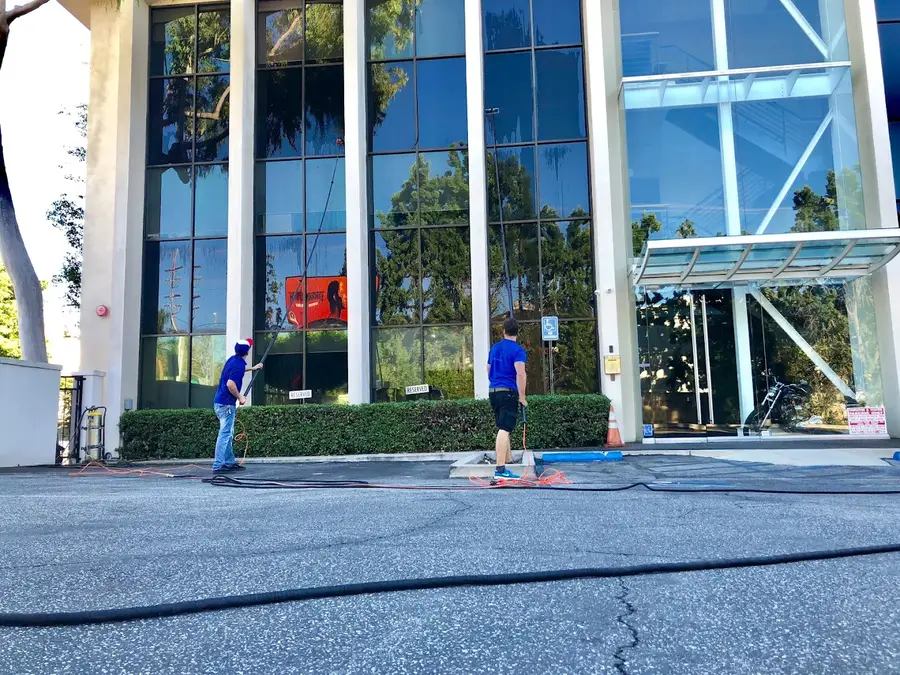
Exteriors are done first because rinse water can flag interior glass — but never the reverse. Interiors are finished last to protect the spotless final result.
04 · Water-Fed Pole or Ladder
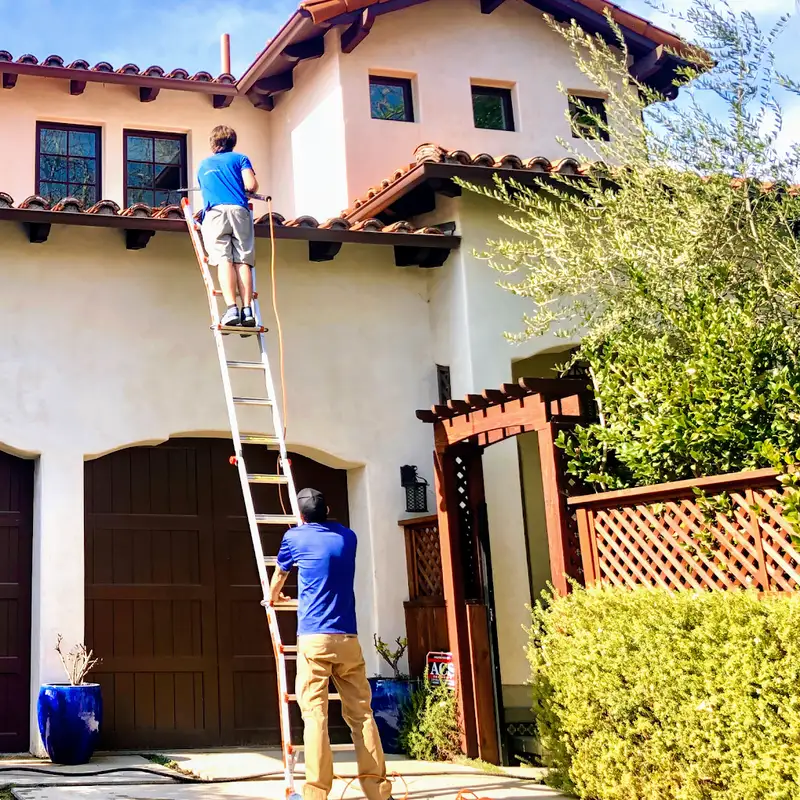
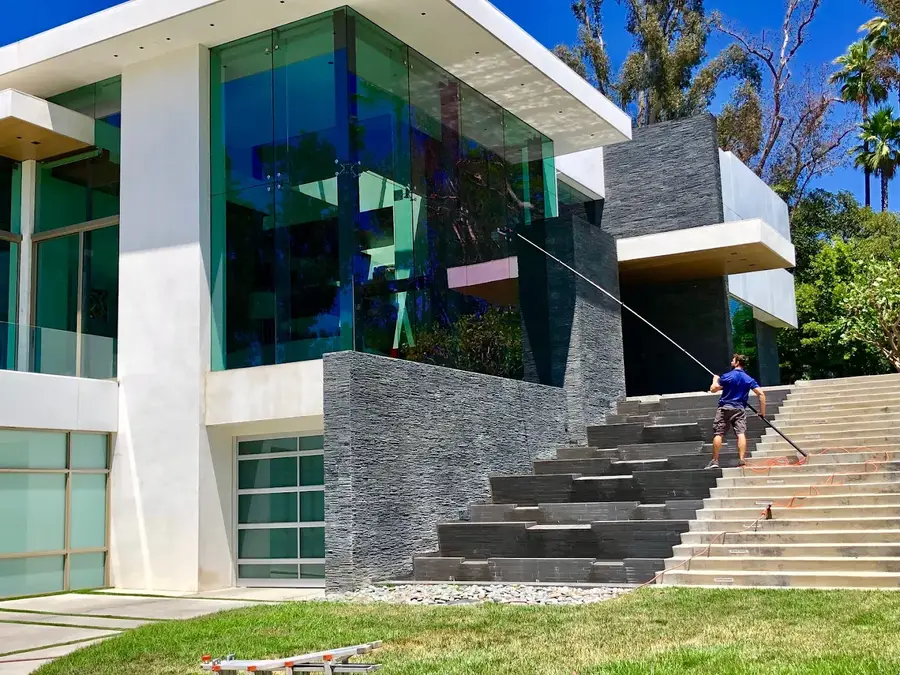
For upper stories, water-fed poles with deionized water reach up to 60+ feet without ladder placement. Ladders only when geometry requires it, and always with footing protection on hardscape.
05 · Sills, Tracks, Frames
Sills wiped, frames detailed, hardware checked. Deep track cleaning with steam is offered as an add-on for windows that haven't been serviced in a year-plus — common after construction or remodeling.
06 · Final Walk-Through
We walk the property with you again at the end. Anything not right is addressed on the spot. You inspect before we pack up. No exceptions.
Cleaning is temporary. Protection is the answer.
— Clean once. Protected for months. —
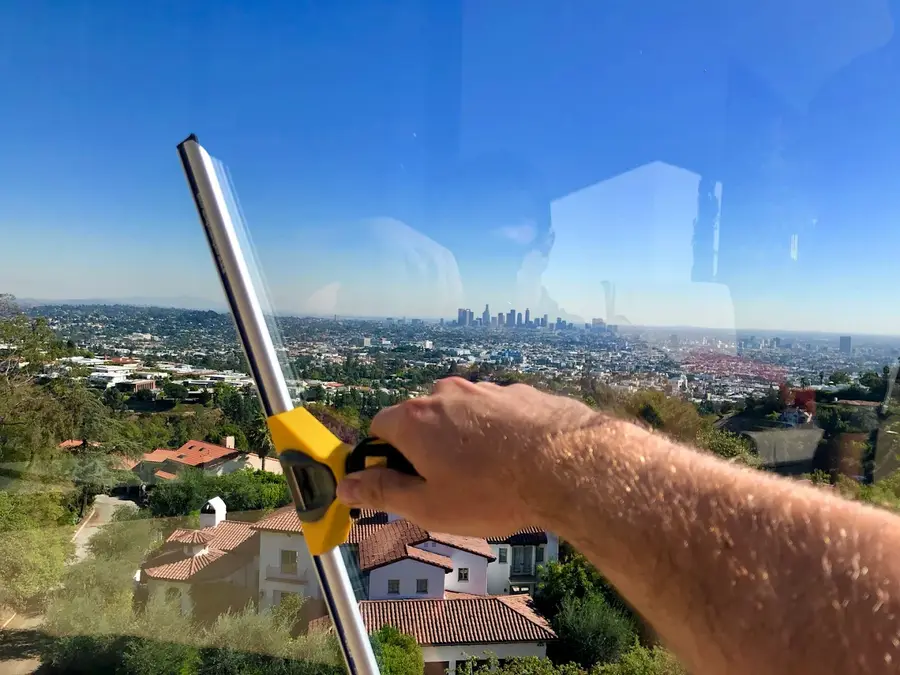
Saphir is our glass protection system — two tiers of nano-bonded coatings that don't sit on top of the glass like a film, but bond at the molecular level. Once applied, water beads up and rolls off, dust has nothing to grip to, and fingerprints, nose prints, and smudges wipe away cleanly instead of etching in.
The honest truth: almost nobody coats every window in their home. It's not necessary, and it's not the smartest use of the budget. Saphir is meant for the glass that gets used, touched, or punished the hardest — and we'll help you identify which panes those are during the walk-through.
The foundation layer. A nano-technology coating that creates a water-repelling, dust-shedding barrier on the glass surface. Rain, salt spray, irrigation overspray, and environmental debris bead up and roll off instead of bonding.
- Hydrophobic — water beads and rolls off
- Reduces hard water spotting and mineral buildup
- Cuts cleaning frequency in half on coated panes
- Ideal for: oceanfront homes, sprinkler-zone glass, exterior-facing panes
- Applied after a complete professional cleaning
Everything Saphir does, plus a denser, harder molecular bond that resists physical contact. Fingerprints, nose prints, dog smudges, elbow marks from hands-full back-door moments — they wipe away instead of etching in.
- All hydrophobic benefits, longer-lasting
- Resists fingerprints, smudges, pet contact
- Lasts up to 3 years depending on exposure
- Ideal for: french doors, slider panels, kid/dog zones, family rooms
- The highest-touch glass becomes the easiest to keep clean
The smart money play: hydrophobic + bi-annual cleaning.
Here's the honest math most window cleaning companies won't tell you. Saphir hydrophobic on your most-used panes, paired with bi-annual professional cleaning, beats almost every other combination on cost for most LA homes. Ceramic (Saphir+) is excellent — but it's for specific glass with specific problems, not the default upsell.
One scenario only. The numbers below model a typical mid-sized LA home on a quarterly cleaning schedule with ocean-facing windows. Your numbers will be different depending on home size, exposure, water hardness, and which panes get protected. Use this as a framework to compare against your situation — not a guarantee. Your estimator will run your actual numbers during the quote.
What gets hydrophobic — strategic targeting, not every window.
Pricing here is for hydrophobic Saphir only — the 6–9 month protection tier. Ceramic Saphir+ (12–36 month protection) is priced separately and is only recommended on specific high-touch panes — see the ceramic note further below.
The cost-savings only work because we protect the right panes — the ones that get dirty fastest from daily use, salt air, or pool splash. Treating every window is a waste; treating none misses the opportunity. For a typical LA home we protect ~10 strategic panes with hydrophobic Saphir at $45 per pane = $450:
- · Rear-of-house sliding glass doors
- · Pool-area glass railings
- · Ocean-facing picture windows
- · French doors with daily traffic
- · Skylights (when accessible)
- · Glass wine-room enclosures
All numbers below assume the 10-pane reference scenario ($450) for clarity. Real-world scope varies — smaller homes may only need 4–6 panes, larger oceanfront estates can run 16–20 panes. Your estimator will run your actual scope during the quote.
How the savings actually work
Both paths below assume you're on Elite Club membership — that's the baseline. The real question isn't whether to be a member; it's whether to add Saphir hydrophobic and drop to bi-annual cleaning, or skip the treatment and stay on quarterly. Each professional cleaning runs $500/visit; Saphir runs $45/pane on ~10 strategic panes ($450). The membership discount applied to each path is the standard tier rate for that service rhythm.
| Approach (both assume Elite Club membership) | Service subtotal | Member discount | Annual cost |
|---|---|---|---|
|
Quarterly cleaning, no treatment 4 cleanings × $500 — needed because glass keeps getting dirty between visits |
$2,000 | −$360 (18%) | $1,640 |
|
✦ Best value Bi-annual + Hydrophobic Saphir 1st visit: $500 cleaning + $450 Saphir (10 panes × $45) = $950 · 2nd visit: $500 cleaning · Half the service days, glass stays clean between visits, plus member perks |
$1,450 | −$174 (~12%) | $1,276 |
| Annual savings — choosing treatment over quarterly cleaning | −$364 | ||
Member discounts are what unlock both options at the rates shown — non-members pay full retail. If you're already considering membership, the smart play is adding Saphir + bi-annual: $364/yr saved vs staying on quarterly cleaning, half the service days per year, glass stays clean between visits, and member perks (priority scheduling, complimentary add-ons, points toward future credits) apply either way.
Membership tiers aren't selected — they're earned through points accumulated on each service, similar to a credit card rewards program. As your point balance grows, higher-tier discounts and perks unlock automatically. The 18% and ~12% figures above reflect typical mid-tier rates so you can see how the math works; your actual discount can be higher as your point level climbs. Homes that would otherwise be on monthly or oceanfront-aggressive schedules save more than this table shows. Homes that would otherwise only clean annually save less or nothing — at that frequency, protection isn't doing economic work for you.
When ceramic (Saphir+) is worth it: only on specific high-touch panes that get punished daily — french doors with kids and dogs, slider panels in family rooms, glass railings near the pool. For those, the longer 12–36 month protection life justifies the cost. For everything else, hydrophobic + maintenance is the smarter play.
Not every window needs protection.
The smartest use of Saphir is on the 20% of your glass that creates 80% of your cleaning headaches. Here's how we identify it together.
-
✦
French doors & sliders
The highest-touch glass in any home. Fingerprints, nose prints, paw smudges — daily. Saphir+ pays for itself within months on these panes alone.
-
✦
Ocean-facing windows (Malibu, Pacific Palisades, Santa Monica)
Salt spray bonds to untreated glass within days. Saphir's hydrophobic layer reduces salt adhesion dramatically, especially in oceanfront homes where cleaning every few weeks becomes the norm.
-
✦
Sprinkler-zone glass
Irrigation overspray is the #1 cause of permanent hard water etching in LA. If you can hear sprinklers from inside a window, it's a Saphir candidate.
-
✦
Skylights and unreachable architectural glass
Anything that's expensive or risky to re-clean is worth protecting. Saphir+ extends the interval between professional cleanings, which means fewer ladder/lift jobs over the life of the coating.
-
✦
Glass railings & pool-area panels
Constant water contact, chlorine exposure, and reflection visibility. Coated glass stays presentable between professional services and resists chemical bonding.

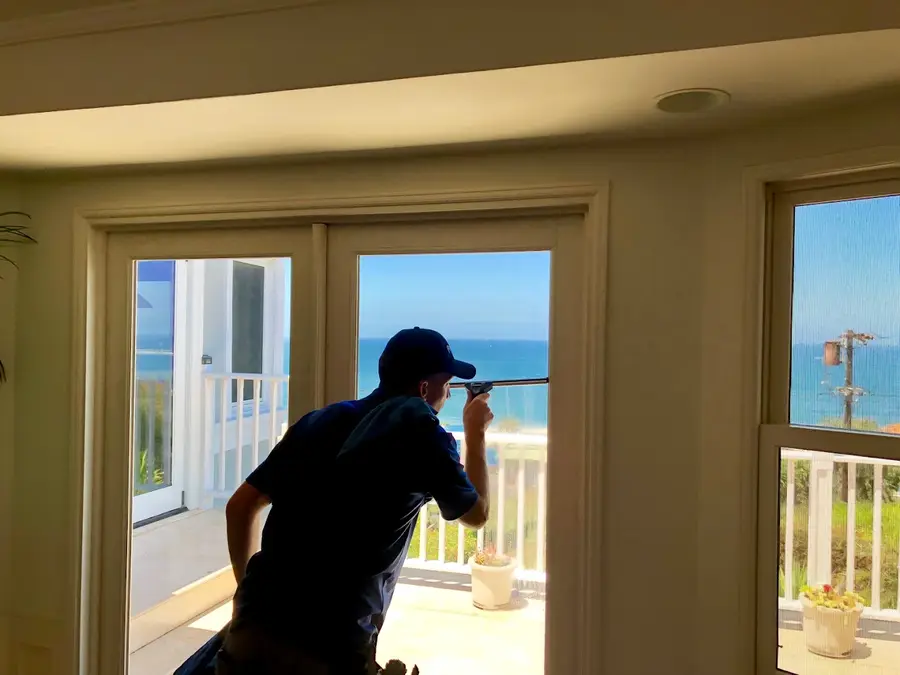
Bi-annual is the sweet spot. Here's why.
Most LA homes don't need quarterly cleaning to look great. They need a smart twice-a-year rhythm that lines up with how the seasons actually beat up your glass — and your social calendar.
After the rains, before the parties.
Coming out of LA's rainy season, glass is covered in mineral runoff, irrigation overspray, and seasonal grime. Spring cleaning resets your windows just in time for graduations, weddings, Mother's Day, garden parties, and the bright-light months when streaks become obvious.
After the heat, before the holidays.
Summer in LA is brutal on glass — heat bakes hard water spots, irrigation, dust, and salt air into the surface. Fall cleaning clears all of it before holiday gatherings, family visits, and the lower sun angle that makes every smudge visible from the inside.
The honest cadence guide
Annual is the floor — it prevents permanent hard water etching, which is far more expensive to address than preventive cleaning. Bi-annual (Spring + Fall) is the rhythm we recommend for most LA homes — it matches the seasons, your social calendar, and the realistic life of clean glass. Quarterly is for clients who simply want their glass spotless year-round, oceanfront properties, or homes with specific exposure issues — and pairs beautifully with hydrophobic protection on key panes.
Ask us what cadence makes sense for your home — recurring service relationships include relationship pricing that improves the more you bundle.
Why glass gets dirty faster in some neighborhoods than others
Los Angeles isn't one climate — it's a dozen. What clouds your windows depends entirely on where you live, and we clean for the specific conditions your home actually faces.
We clean windows across all of Los Angeles County — Beverly Hills, Bel Air, Holmby Hills, Malibu, Pacific Palisades, Santa Monica, Brentwood, Venice, Marina del Rey, Pasadena, San Marino, La Cañada, Glendale, Burbank, Sherman Oaks, Studio City, Encino, Tarzana, Woodland Hills, Calabasas, Hollywood Hills, West Hollywood, Hancock Park, Los Feliz, Manhattan Beach, Redondo Beach, Palos Verdes and the surrounding communities.
Not sure how often your home's windows need cleaning for your area? Send us your address and we'll give you an honest recommendation — no upsell.
Window Cleaning & FAQ
How long do professionally cleaned windows actually stay clean?
Without protection, exterior glass in Los Angeles typically starts showing buildup within 3–6 weeks in coastal zones (salt spray) and high-traffic areas (exhaust, road dust), and 6–10 weeks in inland residential neighborhoods.
Interior glass holds up much longer — usually 2–4 months before fingerprints, dust, and pet contact become noticeable, unless you have kids or dogs that frequent specific doors.
With Saphir hydrophobic or Saphir+ ceramic protection, both intervals extend significantly — often double or triple the unprotected lifespan on coated panes.
What's the actual difference between Saphir and Saphir+ Ceramic?
Saphir (hydrophobic) creates a water-repelling layer. Rain, salt spray, irrigation overspray, and dust have a much harder time bonding. It lasts 3–9 months depending on exposure, and is the right choice for most exterior glass and oceanfront homes.
Saphir+ (ceramic) uses a denser, harder molecular bond. It does everything Saphir does, plus it resists physical contact — fingerprints, nose prints, paw smudges, elbow marks. Lasts 12–36 months. Best for high-touch glass: french doors, slider panels, family rooms with kids and dogs.
Many clients use both — Saphir on the exterior-facing windows where weather is the enemy, Saphir+ on the high-touch interior doors where hands and paws are the enemy.
Do I have to coat every window, or can I do just some?
You can do just some — and you probably should. We don't recommend coating every window in your home. The smart approach is to identify the 8–15 panes that create most of your cleaning frustration (the doors you touch daily, the ocean-facing ones, the sprinkler-zone windows) and coat only those.
This typically costs $400–$1,500 depending on coating tier and pane count, and saves significantly more than that over the life of the coating in reduced cleaning frequency.
During the walk-through, we'll point out which panes qualify and which don't. No upsell pressure on glass that doesn't need it.
Can Saphir fix windows that already have hard water stains?
Honestly? No. Hard water etching is below the surface of the glass — it's calcium and silica that have bonded into the glass itself. Saphir bonds to the surface, so it sits on top of the etching, not in it. The etching stays visible.
For newer mineral deposits that haven't fully etched yet, we have specialty restoration treatments that may reduce or remove the stains before applying Saphir. We assess this case-by-case and tell you upfront what's realistic.
The honest move with permanently etched glass: either live with it (in non-prominent areas) or replace the pane (for high-visibility windows). Saphir prevents future etching from happening on protected panes — that's its job.
How often should my windows be cleaned in Los Angeles?
The honest answer depends on your property's exposure:
Annual minimum for every LA home. Annual cleaning is what prevents permanent hard water etching — which is far more expensive to address than preventive cleaning.
Every 6 months for most inland residential properties. This is the sweet spot for keeping presentation consistent without overspending.
Quarterly for properties near busy roads, in dustier valley zones, or with heavy sprinkler exposure. Also typical for high-end homes that prioritize presentation.
Monthly for true oceanfront properties (Malibu, Pacific Palisades, beach cities). Salt air is relentless and benefits from the most frequent service.
With Saphir or Saphir+ protection, you can typically stretch the next professional cleaning by 40–70% on coated panes — which is most of where the savings come from.
What's actually included in a standard window cleaning service?
Included on every appointment: Hand-finished cleaning of all accessible interior and exterior glass, sill and frame wipe-down, light screen dusting, hardware checks, floor protection, and a final walk-through inspection before we leave.
Add-ons available: Deep screen washing (removes pollen, road dust, embedded debris), deep track cleaning with steam (removes years of buildup from sliding window/door tracks), screen repair and replacement, and Saphir or Saphir+ glass protection.
We quote add-ons separately so you see exactly what each costs. No bundled "premium packages" that hide the math.
What if I'm not happy with the result?
We don't leave until you've inspected the work and approved it. Final walk-throughs are mandatory on every appointment — not optional, not for "premium" packages only. If something is not right, we address it on the spot before we pack up.
After the appointment, if a window streaks or spots within 48 hours under normal conditions, we come back and re-do it at no charge. This has been our policy for 25+ years.
Are you licensed, insured, and NDA-friendly?
Yes to all three. LA Elite Window Cleaning Inc. is fully licensed, bonded, and insured in California — general liability and workers' compensation coverage. Certificates of insurance are available on request for property managers, HOAs, and commercial clients.
We regularly work on high-profile and high-security properties throughout Beverly Hills, Bel Air, Malibu, and Holmby Hills. NDA requirements, gate protocols, and security expectations are standard practice for us.
Clean once. Protected for months.
No pressure, no commitment. Get a transparent quote, hear what we'd actually recommend for your home, and decide from there.