Solar Panel Cleaning · Manufacturer-Approved · Los Angeles County

The sun is up for so many hours. Don't waste any of them.

— Clean panels. Maximum collection. Investment protected. —

Solar panels only earn when the sun is shining — and dust, pollen, salt spray, irrigation overspray, and hard-water haze quietly steal output from every minute of that window. Studies put real-world soiling losses in LA at 15–25% for arrays that go a year between cleanings. We restore output with manufacturer-approved methods: deionized water, soft brushes, no pressure, no chemicals, no damage to the investment you've already made.

The Craft

Every hour of sun is the only window you have.

Solar panels only collect when the sun is up. That's the entire earning window — and every dirty, dusty, or hard-water-spotted minute inside that window is income you don't get back. Keeping the glass clean isn't a luxury. It's what your panels were rated on the day they were installed.

Never spray your panels with a garden hose. Standard tap water in LA County is among the hardest, most mineral-concentrated water in the continental United States — and there's a reason for that. The majority of LA's water is sourced from the Colorado River, which carries high levels of calcium and magnesium that municipal treatment doesn't filter out. Unless your home has a whole-house soft water system, what comes out of your hose is loaded with the exact minerals that bond to hot glass. When that water evaporates off your panels — and in LA heat, it evaporates fast — those minerals stay behind, bond to the anti-reflective coating, and etch into the surface permanently. Each rinse makes the next layer harder to remove.

And never use chemicals. In LA's heat, soap or cleaner residue dries onto the cells before you can rinse it off — and once dried, those chemicals damage the photovoltaic layer underneath the glass. That damage is not repairable. The panel is ruined and your investment goes down with it.

The right method is boring on purpose: deionized or filtered water (no minerals to deposit), soft natural-fiber brushes (no scratches to the anti-reflective coating), no chemicals (no residue, no warranty risk), and a careful pass that lifts the dust film without disturbing the cells underneath. It's the same water-fed pole system we use for high-rise glass — and it's what every major panel manufacturer accepts as compliant.

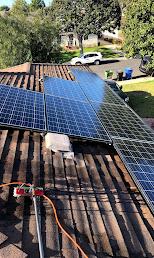
Technician cleaning rooftop solar panels with water-fed pole
What We Use

Four things on the roof. Nothing else.

Every component in our solar cleaning kit is chosen because manufacturers explicitly approve it — or because not using it would void your warranty. That's the entire selection criteria.

Deionized or Pure Water

LA's municipal water comes mostly from the Colorado River — high in calcium and magnesium that standard treatment doesn't remove. When that water evaporates off hot solar glass, those minerals bond to the anti-reflective coating and reduce light transmissivity permanently. We use deionized or filtered pure water on every job so the panels dry spot-free and residue-free — exactly what the manufacturers specify for cleaning in hot-climate installations like LA.

Mineral-free · spot-free drying · manufacturer-recommended for hot climates

Soft-Bristle Solar Brushes

Designed specifically for photovoltaic glass — natural or microfiber bristles soft enough to lift the dust film without scoring the anti-reflective coating. We replace brush heads on a rotating schedule before the bristles stiffen with age. No stiff scrubs, no abrasive pads, no household sponges.

Manufacturer-approved · replaced before wear · no micro-scratching

Water-Fed Pole System

The same telescoping pole system we use for high-reach window work. Lets us reach across the array from the eave or a stable ladder position — minimizing time spent walking on the panels themselves, which is the #1 cause of installation damage during cleaning. Less weight on the cells. Less risk to your investment.

Ground- or eave-based reach · minimal panel traffic · stable footing

Zero Chemicals

No soaps, no detergents, no degreasers, no spot-removers. In LA's heat, chemical cleaners dry onto hot panels faster than you can rinse them — and once dried, those residues damage the photovoltaic cells underneath the glass. That damage is not repairable. The panel is ruined, output drops permanently, and the warranty is void. Just water and the mechanical action of a soft brush, done properly, removes the dust film without any of that risk.

No residue · no permanent cell damage · safe for cells, frames, sealants
Rooftop solar array with downtown Los Angeles in the background
The reality nobody tells you

A 10kW system losing 15% to soiling is leaking roughly $300–$500 of free electricity every year. The cleaning pays for itself.

Why It Matters

Soiling losses are real. And they compound.

— A slow leak in your investment. —

Industry research from the National Renewable Energy Laboratory and independent installers consistently shows that uncleaned solar panels lose 5% to 30% of their rated output depending on local conditions. In Los Angeles, where we get long dry stretches, ocean salt, irrigation overspray, and seasonal pollen, real-world losses commonly land in the 15–25% range for arrays that go more than 12 months between cleanings.

The loss isn't dramatic on any single day — it's a quiet daily underperformance that adds up. Most homeowners don't notice until their utility bill creeps back up, or their monitoring app shows production curves shorter than they used to be.

Solar array panels with detail of clean glass surface

The honest math on a typical LA home array

This is a reference scope — your numbers depend on system size, your utility's rate, and how much you generate vs. consume. But the shape of the math is the same on almost every home.

10 kW Typical residential array size
~15% Average annual soiling loss (LA)
$300–$500 Annual production loss at typical rates
2×/yr Recommended cleaning cadence in LA

Bi-annual cleaning recovers most of the soiling loss for the full year. The cleaning cost is typically a small fraction of the production recovered — meaning the service pays for itself, with the rest going back into your utility offset.

A small investment that protects a big one.

Your solar array is one of the largest investments in your home. A bi-annual cleaning service is one of the smallest. What the small one does for the big one is significant:

You earn more during every hour of sun — clean panels collect at full rated efficiency instead of leaking 15–25% to dust and mineral haze. With net metering, the surplus from a fully-performing array can actually result in the utility paying you in months where you generate more than you use.

And your panels last longer. The two things that actually shorten a panel's working life are physical damage (cracked glass, broken cells) and permanent surface degradation (mineral etching, chemical residue burned into the photovoltaic layer). Proper cleaning prevents both. A panel that's cleaned correctly twice a year — never hosed, never chemicaled — reaches its full rated lifespan. A panel that's neglected or cleaned wrong loses output every year and dies early.

The math is direct: spend a little to protect a lot. The cleaning earns you back its cost in recovered output, and the longevity it buys is the real return.

Free with any service visit

Is your water quietly damaging the home?

LA tap water is sourced largely from the Colorado River, and what comes through the pipes is loaded with calcium and magnesium that standard municipal treatment doesn't remove. That same mineral content is what etches your windows, builds up on your concrete, dries onto your solar panels, and silently shortens the working life of your pipes, plumbing, fixtures, and water heater — appliances you don't think about until they fail.

While we're already on-site for any LA Elite service, we'll test your tap water at no extra charge. If you already have a softener installed, we'll check whether it's still doing its job. If you don't, we'll tell you honestly whether you need one or if you're fine. And if you already have etching in the glass from years of hard water? That's the last line — we'll tell you what's still recoverable and what isn't.

  • Annual upkeep beats expensive repairs. A small recurring investment in maintenance keeps small buildup from snowballing into etched glass, ruined panels, or a failed water heater — those are the costs that get very large, very fast.
  • The damage is cumulative. Mineral deposits build silently and bond to surfaces over time. By the time you can see them on the outside, your pipes and appliances have been collecting the same buildup on the inside for years.
  • Once etching is in the glass, it's permanent. Surface deposits we can lift. Etching that's burned into the glass over years of hard water is below the surface — we can reduce the visible severity, but the damage stays.
  • A whole-house filtration system protects more than the exterior. The same investment that saves your windows and panels extends the life of your water heater, dishwasher, fixtures, and the entire plumbing run inside your walls.
Pricing

Per-panel pricing. No mystery line items.

Solar work scales with the array. We price by panel count and access difficulty — no flat fees, no padded "service charges," no surprise upcharges on the day of service.

Tier 01 · Standard Access

Single-Story · Low-Pitch Roof

$8per panel
$200 minimum service

Most LA residential arrays. Reachable from a stable ladder or eave, roof pitch under 25°, panels mounted in standard tilt position.

  • Deionized water rinse
  • Soft-brush detail pass on each panel
  • Before/after photos available on request
Tier 02 · Difficult Access

Two-Story · High-Pitch · Tile Roof

$12per panel
$300 minimum service

Steeper roofs, second-story arrays, tile or slate roofing, or arrays requiring lift equipment. Same method, more time and setup.

  • Everything in Tier 01
  • Additional fall-protection setup
  • Tile-safe traffic pads where panels are walked
  • Two-person crew for safety-critical positions
Tier 03 · Commercial / Large Array

50+ Panels · Custom Quote

Customper project
Site visit included

Commercial buildings, large-residential estates, ground-mount arrays, and HOA common-area systems. Pricing reflects volume, access, and ongoing-maintenance contract terms.

  • Volume discount on per-panel rate
  • Scheduled maintenance contracts available
  • Certificate of insurance + COI on request
  • Production-monitoring integration optional
The Right Rhythm

How often do LA panels actually need cleaning?

It depends on environment. Most LA homes land in the 2×/year range. Properties near the coast, near landscaping with heavy pollen, or under flight paths/freeway dust may need more. Inland homes with little nearby vegetation may need less.

AnnualInland · low-dust · light vegetation
QuarterlyCoastal · heavy pollen · commercial

Not sure where your property fits? Send us your address and we'll give you an honest cadence recommendation based on local conditions. No upsell — if annual is fine for your home, we'll tell you annual is fine.

Common Questions

Solar Panel Cleaning FAQ

How much output am I actually losing to dirty panels?

National Renewable Energy Laboratory studies show soiling losses range from 5% to 30% depending on environment. In Los Angeles, real-world losses for arrays that haven't been cleaned in 12+ months commonly land in the 15% to 25% range — higher near the coast, near heavy landscaping, or in dusty inland areas. After a proper cleaning, output typically recovers within hours.

If you have a monitoring app (Enphase, SolarEdge, Tesla, SunPower), look at your daily production curve before and after cleaning. The recovery is usually visible the same day.

Will cleaning void my panel warranty?

No — in fact, not cleaning your panels can void your warranty. Most major manufacturers (LG, Panasonic, REC, SunPower, Q CELLS, Canadian Solar) require routine maintenance to keep coverage active, and accumulated soiling that causes long-term efficiency loss is often excluded from warranty claims.

Cleaning with deionized water and soft brushes — the method we use — is explicitly accepted by every major panel manufacturer. What voids warranties is pressure washing, abrasive scrubbing, chemical solvents, or walking on the cells. We don't do any of those.

If your installer or manufacturer has specific written cleaning guidance, send it to us before the appointment and we'll match the method exactly.

Can I just clean them myself with a hose?

We strongly recommend against it. The reason is the water itself: LA County draws most of its municipal water from the Colorado River, which is high in calcium and magnesium that standard treatment doesn't remove. Unless your home has a whole-house soft water filter, what comes out of your hose is among the hardest water in the continental United States — and the worst possible thing you can spray on hot solar glass.

When that water evaporates off your panels, the minerals stay behind and bond to the anti-reflective coating. Over time those deposits etch into the glass, reduce transmissivity permanently, and accelerate the very output loss you were trying to prevent. Every rinse with hard tap water makes the next layer harder to remove.

If you absolutely must rinse between services, only do it early morning when the panels are cool, and even then expect it to do more harm than good in the long run. Proper deionized-water cleaning 1–2× per year is what undoes the buildup and what manufacturers actually recommend.

Are you insured?

Yes. LA Elite Window Cleaning Inc. carries general liability and workers' compensation coverage in California. Certificates of insurance are available on request for property managers, HOAs, and commercial clients.

What if it rains right after you clean?

Rain is fine — it doesn't hurt the panels and it doesn't undo a proper cleaning. LA rain is generally clean enough that you won't see spotting, and our deionized rinse leaves no mineral film for rain to disturb.

That said, rain is a natural occurrence and falls outside our 7-day workmanship guarantee. We don't re-clean for weather. (The 7-day guarantee covers streaks, brush marks, or missed spots from our work — not anything caused by rain, irrigation overspray, or other outside factors.)

Can the panels be cleaned while I'm not on site?

Yes. We can complete a solar cleaning while you're away — most appointments are exterior-only and only need roof access.

For off-site appointments, payment is collected prior to the service. When we wrap up, we'll text before-and-after photos so you can see the work was completed.

If you spot streaks or brush marks from our work in those photos, let us know and we'll come back to correct them — that's covered by our 7-day workmanship guarantee.

What's included in your standard solar cleaning?

Every solar service includes a deionized water rinse of all panels and a soft-brush detail pass on each module — done with the same water-fed pole system we use for high-rise glass. For off-site appointments, before-and-after photos are texted when the job is complete.

What we do not do: we are not licensed solar installers, electricians, or engineers. We can't diagnose performance issues, troubleshoot wiring, or evaluate panel-level defects. If something visible catches our eye during cleaning we may mention it, but any diagnostic or repair work belongs with your installer.

Ready when you are

Clean panels. Restored output.

No pressure, no commitment. Send us your address, and we'll give you a panel count, a price, and an honest cadence recommendation based on local conditions.

Get a Quote Call